
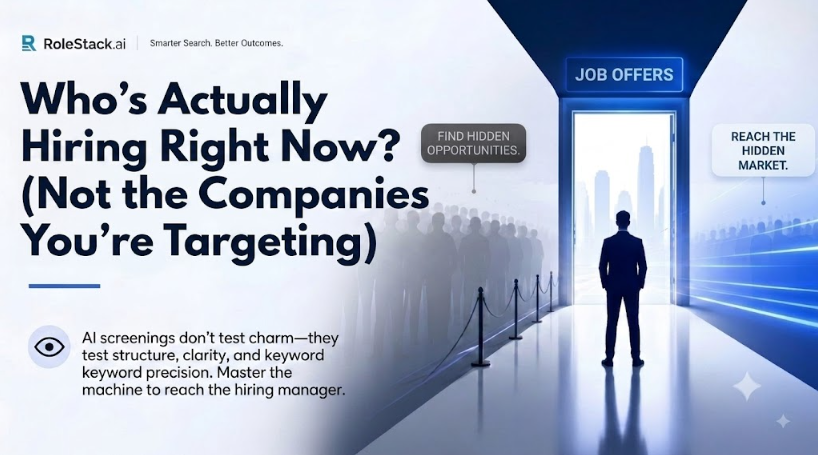
Ask most job seekers where the good roles are, and you’ll get the same twenty names: the big
consumer-tech companies, plus whichever AI lab is in the headlines that week. So everyone applies to
the same handful of employers; competition for those roles is brutal, and thousands of other openings
sit with a fraction of the applicants.
Rolestack pulled 2,585 recent postings across product, engineering, and program management to see who’s
actually doing the hiring. The answer is mostly not the companies people are targeting.
Amazon leads. Then it gets interesting.
One name tops every category: Amazon was the single largest hirer in product, engineering, and
program management alike. After that, though, the lists diverge in ways that say a lot about where each
function actually lives.
Product’s quiet giant is finance
If you picture product management as a Silicon Valley job, the postings will surprise you. Among the
large, recognizable employers, financial services posted more product roles than Big Tech did. Capital
One alone had more product openings than any company except Amazon; Citi, USAA, and Fiserv weren’t
far behind. Add healthcare (Cigna, McKesson) and media (Disney, Warner Bros. Discovery, Comcast) and
a picture emerges, the biggest product employers are the enormous, un-trendy companies quietly
digitizing everything they do. They need product managers badly, and comparatively few applicants
think to look there.
Program management is a physical-world job
This is the assumption that flips hardest. Program and project management gets filed under “tech,” but
the hiring says otherwise. Take Amazon out of the picture and the most prolific program-management
employers are construction and infrastructure firms Turner & Townsend, AECOM, Parsons, JLL and
defense contractors: Northrop Grumman, Boeing, RTX, Anduril. Roads, buildings, aircraft, weapons
systems, and public infrastructure all run on program managers, and those industries were hiring far
more of them than software companies were. If you have program-management experience and you’ve
only been applying to tech, you’ve been fishing in the smallest pond.
Even engineering isn’t all AI labs
The engineering list has the usual suspects Amazon, ServiceNow, NVIDIA, Snowflake, Salesforce,
but two clusters underneath them are easy to miss. Defense is one: Anduril was among the very top
engineering employers, with Northrop and RTX close by. Finance is the other: LPL Financial, State Street,
Capital One, Citi, and Fidelity were all hiring engineers in volume. And going unglamorous doesn’t cost
you; defense engineering roles carried a median around $223K, within striking distance of Big Tech
and above what finance paid. The AI labs are real, and they’re hiring, but they’re a slice of the market,
not the market.
There is no shortlist
Here’s the structural fact under all of it: hiring isn’t concentrated. The top ten employers in each
category accounted for just 12 to 19% of the postings, spread across 500 to 800 different companies.
There’s no tidy list of five names to watch, and no single careers page you can camp on. The roles are
scattered across a very long tail of companies most people have never thought to check.
That’s inconvenient, but it’s also the opening. Those same twenty consumer-tech companies are hard to
get into precisely because everyone applies to them. A bank, a defense contractor, or an infrastructure
firm might move faster on your application for the opposite reason far fewer people bothered. The
best-kept secret in the job market isn’t a company. It’s a category: the large, essential, deeply un-trendy
ones hiring in volume and hoping you’ll notice.
The roles are where you’re not looking. That’s usually where they are.
Sources
• RoleStack internal data: 2,585 roles tracked from posting to publication, across product, engineering, and program management