The AI interview is the most disliked stage in hiring right now, and it might also be the easiest one to get past.
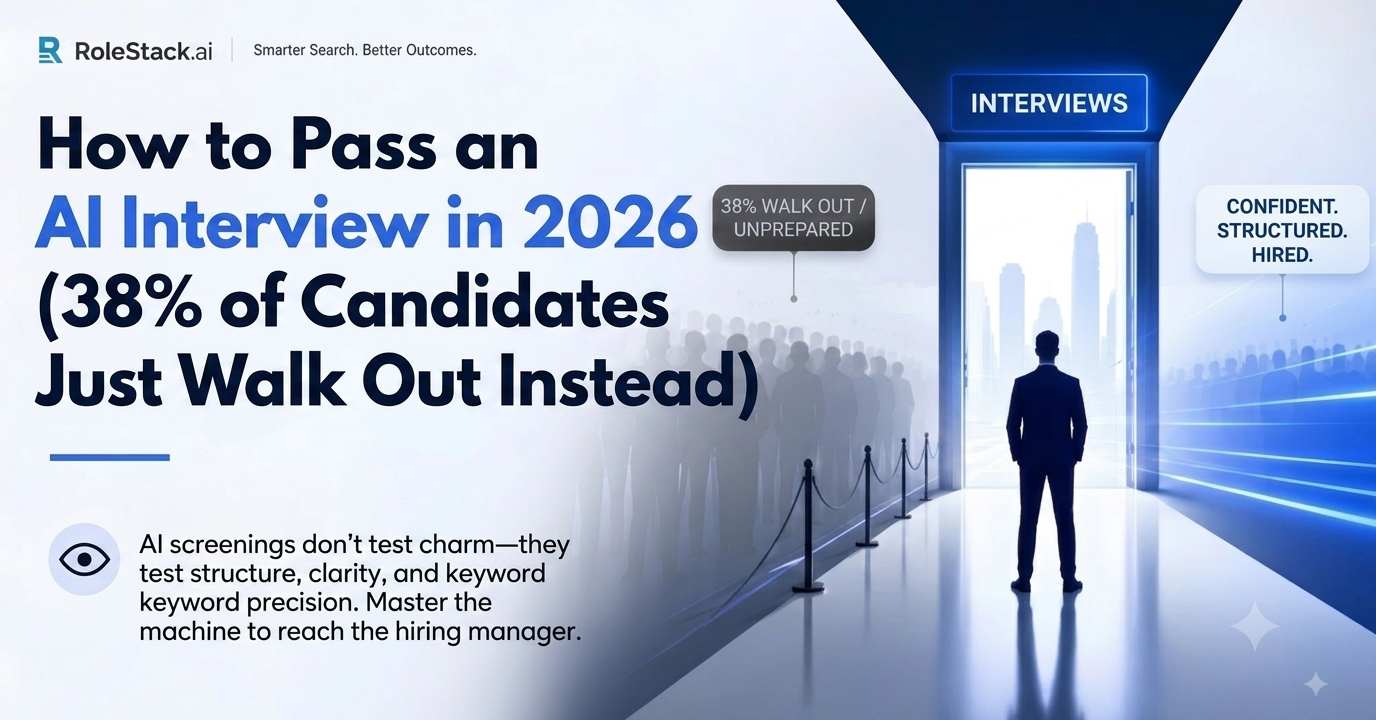
Greenhouse surveyed 2,950 active job seekers across the US, UK, Germany, Ireland and Australia in May 2026. 38% of US candidates had abandoned a hiring process because it involved an AI interview, and another 12% said they’d only sit through one if there were no other option. Of the people who did finish an AI interview, 28% moved to the next round.
For comparison, CareerPlug’s recruiting metrics report, built on more than 10 million applications, puts application-to-interview conversion at about 3%.
Those aren’t the same denominator and I don’t want to pretend they are: the 3% counts everyone who applied, while the 28% only counts people who already got far enough to be handed an interview link. The gap is still wide enough to be worth staring at, mostly because the AI interview is increasingly the screen itself rather than something that happens after it.
What an AI interview actually is now
Somewhere between 21% and 23% of US organizations use generative AI to run at least the first interview, according to TestGorilla and ResumeBuilder data. HireVue alone processed nearly 20 million assessments and video interviews in the first quarter of 2024. Resume Now’s survey of 900+ US hiring professionals found 96% now use AI for at least some recruiting tasks, and SHRM’s 2025 survey of over 2,000 HR professionals clocked AI adoption across HR functions jumping from 26% to 43% in a year.
The mechanism is boring and it explains everything. A recruiter phone screen costs thirty minutes of a salaried human being’s time, and an AI screen costs cents. The reason the resume filter was so brutal was never that companies enjoyed rejecting people, it’s that a human could only talk to twelve candidates a week and four hundred had applied. Take that constraint away and the rational move is to let more people talk.
So this is, weirdly, the first thing to happen to hiring in a decade that widens the funnel rather than narrowing it, and it’s getting the worst reception of anything in years.
Where my theory nearly fell apart
I liked that argument a lot until I found the cheating data.
Fabric, an AI interview platform, analyzed 19,368 interviews on its own system between July 2025 and January 2026 and flagged 38.5% of candidates for cheating behavior. Worse for my thesis: 61% of the ones it flagged scored above the passing threshold. Technical roles ran 48%, sales 12%, and junior candidates cheated at double the rate of senior ones. Dedicated tools like Cluely and Interview Coder accounted for 45% of it, voice-mode LLMs another 34%.
Treat that number carefully. Fabric sells cheating detection, ran the study on its own platform, set its own probability threshold at 40%, and has an obvious commercial interest in the answer being alarming. Resume Genius, asking candidates directly, got 22% admitting to using AI assistance during live interviews. Lower, same direction.
Either way, some meaningful chunk of that 28% advance rate is a person with a second monitor. The door is open partly because nobody’s checking IDs yet.
(Cheating peaked on Sundays at 47.1%, which is the most relatable statistic in this entire piece.)
Why people are walking out, and whether they’re wrong
The Greenhouse numbers on this are damning and they’re not really about the technology. 70% of candidates were never told upfront that AI would evaluate them. One in five only worked it out once the interview had started. The top reason for quitting was a pre-recorded video scored by AI with no human present, at 33%, followed by non-disclosure at 27% and monitoring at 26%.
And then 51% of people who completed an AI interview got no follow-up at all. Not a rejection, nothing. 13% got a formal no.
So cheaper screening bought volume without buying any courtesy, and the ghosting problem everyone blamed on recruiter workload turns out not to have been a workload problem.
There’s a real harm case underneath the annoyance, too. In March 2025 the ACLU of Colorado filed a complaint with the Colorado Civil Rights Division and the EEOC against Intuit and HireVue, alleging that an AI video interview platform discriminated against a deaf and Indigenous employee applying for a promotion, that her request for captioning was denied, and that she was rejected on communication style. The claims cite the ADA, Title VII and the Colorado Anti-Discrimination Act. Both companies deny it. HireVue’s CEO called it “entirely without merit” and said Intuit did not use a HireVue AI-based assessment. It’s still pending, and it’s the shape of the argument that will keep getting made.
Worth noting that public opinion lost this fight a while ago. Pew found in 2023 that 66% of Americans wouldn’t want to apply to an employer using AI to help make hiring decisions. In 2026, 63% of job seekers have faced one, up 13 points in six months. Preference didn’t turn out to be much of a veto, which is what usually happens when one side of the market has all the leverage.
How to pass an AI interview
The useful thing to understand is what the scoring actually does, because it’s narrower than people assume and the failure mode follows directly from it.
An AI interviewer scores your answer against a structured rubric, and it isn’t inferring anything while it does that. A human screener hears “led the migration” and fills in the scope and the team size and the stakes, because they’ve done the job and they pattern-match. The model just checks whether the thing is actually present in what you said.
Which means the way most people fail isn’t nerves or robotic delivery, it’s under-answering. You give the version of the answer you’d give a human who’d ask a follow-up. There is no follow-up. Say the situation, what you specifically owned, the number, and what happened, in one pass, out loud, because nothing is coming back to prompt you.
The rest is unglamorous. Answer the question that was asked rather than the adjacent one you’d rather answer. Don’t leave three seconds of silence to think, since timing is one of the signals these platforms weight. And check whether the role’s in a state with disclosure rules — Illinois and Colorado have both been tightening transparency obligations on employers using AI in hiring, and if you weren’t told, that’s now sometimes a legal question and not just a rude one.
This window closes
The 28% holds partly because 38% of people walk out. That’s what an opt-out does to a conversion rate: it thins the field at exactly the stage where the odds are best, and everyone who stays inherits the space.
Two things end that. AI interviews normalize, completion rates climb, and the conversion compresses back toward the ugly numbers everything else in hiring has. Or detection tightens, the flagged 38.5% starts getting rejected instead of passed, and the bar moves up. Both are already in motion, and neither takes five years.
I don’t think this is a reason to feel good about how any of it works. Being interviewed by software that won’t tell you it’s software, and then hearing nothing at all half the time, is a miserable experience and 51% of people are living it. But the strategic read and the moral read are different questions, and right now the strategic read is that the stage everyone is boycotting is the least competitive one available.
The people opting out on principle are making a real point. They’re also making it into an empty room.
If the problem is that the good screens are the ones you never hear about until they’ve closed, that’s roughly what we built RoleStack for. It surfaces roles that match what you’ve actually done, early enough to be one of the first people through, rather than the four-hundredth.
Sources
- 63% of Job Seekers Have Faced an AI Interview. Most Haven’t Had a Good One Yet — Greenhouse, May 2026 (n=2,950)
- Job candidates say they’re quitting the hiring process over AI interviews — HR Dive
- Recruitment Funnel Benchmarks 2026, citing CareerPlug’s 10M+ application dataset — Pin
- The State of AI Interview Cheating in 2026: Insights from 19,368 Interviews — Fabric
- The State of AI in Job Interviews 2026 — The Interview Guys (aggregates Resume Now, SHRM, TestGorilla, ResumeBuilder, HireVue figures)
- AI hiring software was biased against deaf employees, ACLU alleges in ADA case — HR Dive
- Americans’ views on use of AI in hiring — Pew Research Center, April 2023
- Colorado and Illinois Advance AI Transparency Obligations for Employers — The Employer Report
- 2026 Global AI in Hiring Report — HireVue (n=3,100+ hiring managers)
- Nearly 4 in 10 job candidates have bailed on a hiring round because it required an AI interview — Fortune