
If you’ve applied to anything in the last year, you’ve probably seen the stat that a third of job postings are fake, and felt a small grim relief. It’s not you, it’s the ghost jobs. I wanted that to be true, so I went digging. It’s half true, which turns out to be more useful than either the panic or the debunk.
The scary number traces to one survey. In a Clarify Capital poll, roughly 1 in 3 employers admitted to keeping job listings up while not actively trying to fill them (Clarify Capital). That’s a real finding from employers’ own mouths, and it’s genuinely bad for the person on the other end refreshing their inbox. But “not actively filling” is doing an enormous amount of work in that sentence, and once you pull it apart the story changes.
Three very different things wearing the same sheet
When a company keeps a posting up without urgently hiring, it’s usually one of three things, and they’re not equally sinister.
The first is the evergreen role. High-turnover, hard-to-fill, often entry-level or sales jobs that a company genuinely will hire for the moment a decent person shows up, because someone quits every week. That posting is “always open” but it’s not a lie. If you’re qualified and you apply, you can actually get that job. More than half of wholesale postings fall into this bucket, which is why that industry looks like a ghost-town on paper and isn’t.
The second is the pipeline post. The company isn’t hiring today but wants a stack of resumes ready for when it is, or is fishing to see what talent is available at what price. Real intent, wrong timeline. You might hear back in four months, or never, but you weren’t imagining the role.
The third is the actual ghost, and it’s the one that earns the genre its name: the posting kept alive purely for theater. In that same survey, 43% of employers admitted to leaving jobs up to keep current staff motivated or to give the impression the company is growing (Clarify Capital). That one is exactly as cynical as it sounds. You’re unpaid set dressing for a company that wants to look like it’s winning.
The viral “a third of jobs are fake” line staples all three together and reports the total as fraud. Only the last one really is.
The debunk goes too far the other way
Then there’s the other camp, which insists ghost jobs are basically a myth. Their best point is a good one: a lot of postings that get called ghosts are attached to companies that are, in fact, interviewing people for them. One industry analysis argued the large majority of supposedly ghostly postings had active interview loops behind them, and that the openings-to-hire ratio has actually cooled from its pandemic peak rather than exploded (LinkUp). Fair. Panic sells clicks, and “the whole market is fake” is both wrong and a great way to talk yourself out of applying to real jobs.
But the debunkers wave off the part that actually matters to you, which isn’t fraud, it’s conversion. In June 2025 employers reported around 7.4 million openings and made about 5.2 million hires (CNBC). Openings and hires aren’t a clean one-to-one, so you can’t cleanly say “a third never hired.” But the gap points at something the job seeker feels in their gut: a meaningful chunk of what’s posted will not turn into a hire on any timeline that helps you, whether from theater, evergreen churn, or a pipeline that quietly closes. And postings are lingering longer than they used to. Fewer than half of jobs posted in October 2024 were filled within six months, a window that used to close faster.
So the honest read is neither “it’s all fake” nor “ghost jobs are a myth.” It’s that a real and rising share of postings are low-intent, and the market has no obligation to tell you which ones.
Who benefits from the fog
The thing nobody applying for a job thinks about is that ghost and evergreen posts aren’t just annoying, they poison the data everyone relies on. Every one of them counts as an “opening” in the national statistics, which makes the labor market look hotter than the actual hiring behind it, which is part of why economists have started flagging that posted openings and real hiring have drifted apart (CNBC).
Follow the incentives and it’s clear who eats the cost. The company posting theater gets to look like it’s thriving for free. The job board gets another listing to show advertisers and another reason for you to keep visiting. The one party paying for the fog in hours and in morale is the applicant, who is told the market is booming while being ghosted by half of it. And it compounds: postings got cheap to leave up at the same moment applications got free to send, so both sides now flood the channel with low-intent noise. Everyone’s bluffing, and the pot is your afternoon.
What to actually do about it
You can’t verify a stranger’s hiring intent, so don’t try. Weight the odds instead.
Freshness is the single best cheap proxy you have. A role posted this morning is far more likely to be real and actively getting reviewed than one that’s been up for four months, because theater and dead pipelines are what accumulate over time. Newly posted, still-specific, single-listing roles on the company’s own careers page carry more signal of intent than something that’s been reposted every few weeks across five boards. None of that is proof, but it tilts the field.
The bigger shift is emotional, and it’s the part I’d actually sit with. If a third of what you apply to was never going to hire anyone on your schedule, then your response rate was never a clean readout of your worth as a candidate, and treating it like one will wreck you over a long search. Some of the silence is you. A lot of it is set dressing. Stop auditing your resume over applications that a person may never have intended to read, and put that energy into the fresh, specific, real-looking roles where a reply is actually on the table.
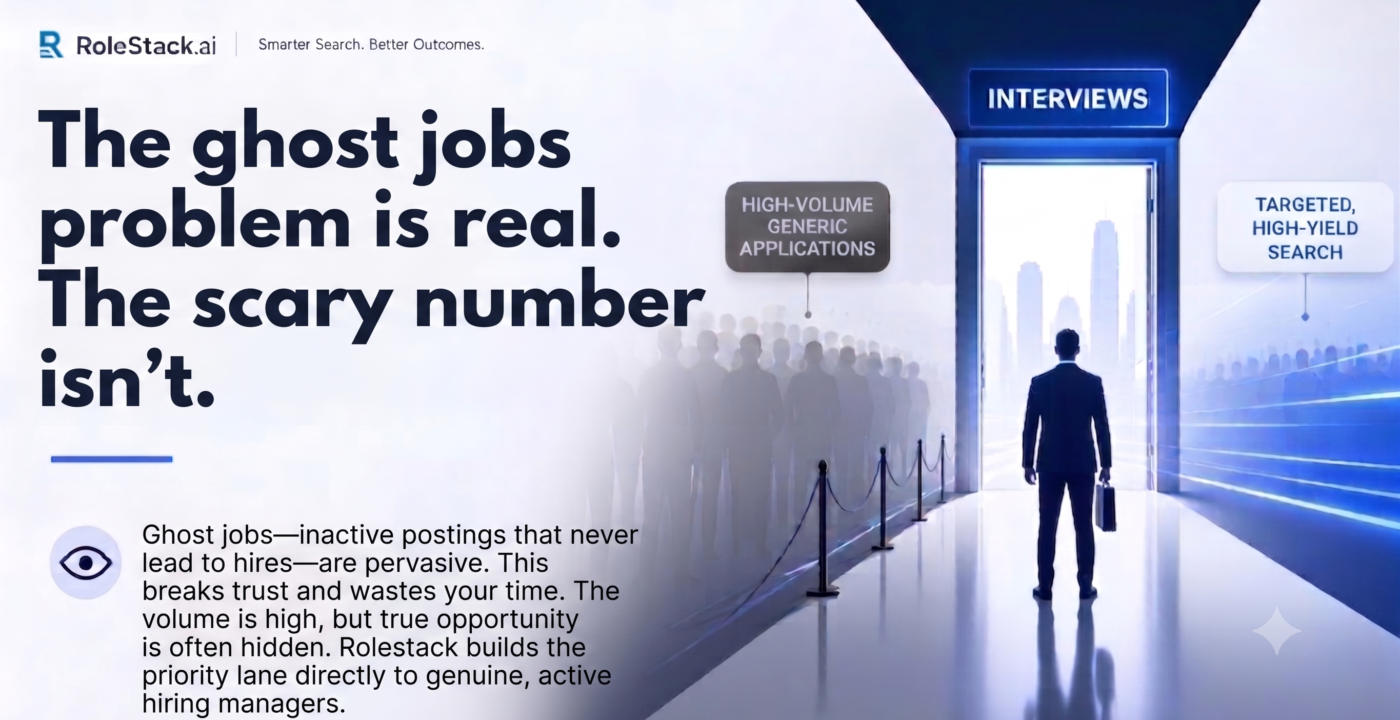
That last part is most of what RoleStack is for. It surfaces freshly posted, high-fit roles early, which skews you toward the postings most likely to be real and actively reviewed and away from the stale evergreen backlog. It can’t read a hiring manager’s mind or promise a role is genuine. But being early and selective is the closest thing to a ghost filter you’ve got. Try RoleStack for Free
Sources:
- Job Seekers Beware of Ghost Jobs (employer survey) — Clarify Capital
- Ghost Jobs Are Haunting the U.S. Job Market — Clarify Capital
- The Absurd Myth of ‘Ghost Jobs’ (the skeptic case) — LinkUp
- Ghost job postings add uncertainty to the stalled jobs picture — CNBC
- Ghost Jobs: Real Concern or Phantom Phenomenon? — SHRM