If you’ve searched for an AI job search tool recently, you’ve probably noticed something. They all promise the same thing.
AI resume tailoring • Auto-apply • Job matching • Application tracking
On paper, they look almost identical. But once you start using them, you realize they’re solving very different problems. Some optimize for finding more jobs. Others optimize for sending more applications.
RoleStack was built around a different question: How do you maximize the chances of getting an interview? That sounds subtle, but it changes almost every product decision.
The real bottleneck isn’t writing applications anymore
Five years ago, writing a tailored resume was the hardest part of job searching. Today, ChatGPT can rewrite your resume in seconds. Auto-apply tools can submit dozens of applications before lunch. The bottleneck has moved.
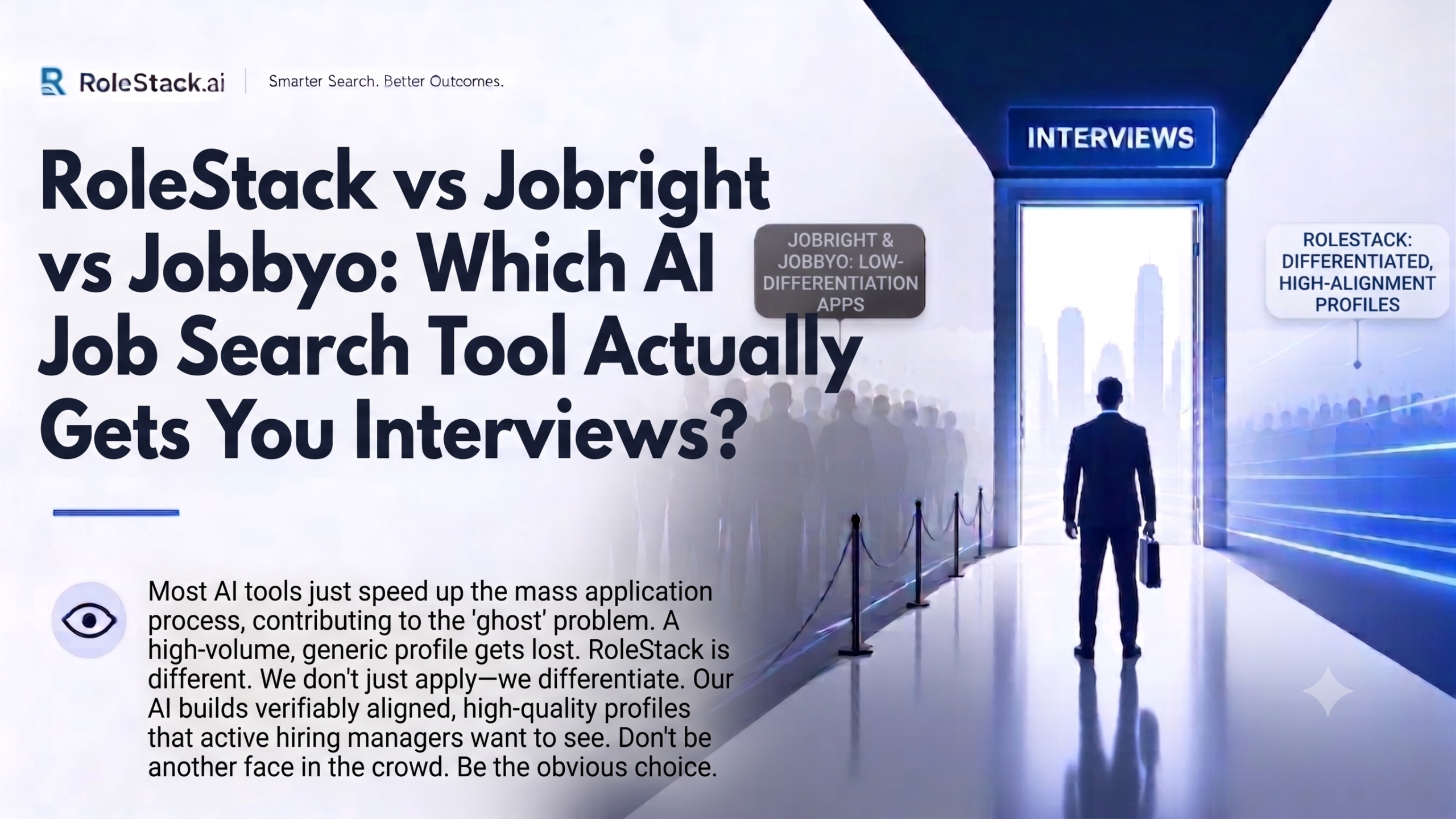
Recruiters aren’t struggling to find candidates anymore. They’re struggling to review them. A single Product Management role can attract over 1,000 applications within days. The challenge isn’t applying. It’s getting seen before the queue becomes unmanageable. That’s the lens we’ll use to compare these platforms.
At a glance
| RoleStack | Jobright | Jobbyo | |
|---|---|---|---|
| Best for | Senior tech professionals who value quality over volume | Broad job discovery & networking | Fully automated, high-volume applications |
| Job discovery | Direct company ATS monitoring | Aggregated listings | Aggregated listings |
| Resume tailoring | Grounded in your real experience | AI-generated rewrite | AI-generated rewrite |
| Auto Apply | Yes | Yes | Yes |
| Application transparency | Full application history | Basic tracking | Review before sending |
| Interview guarantee | ✅ 2 interviews/month or money back | ❌ | 30-day Conditional guarantee |
Feature-wise, they’re all seem capable.
The difference is what they’re optimizing for.
Jobright’s biggest strength is discovery. It indexes millions of listings, recommends jobs using AI, and adds useful extras like alumni connections, referrals, and interview coaching. If your biggest challenge is simply finding opportunities, Jobright does a great job.
Where things become more complicated is after discovery. Because the platform aggregates jobs from across the internet, listings may already be several hours—or even days—old by the time they appear. That matters. Recruiters don’t wait for every application to arrive before reviewing candidates. Many begin screening within the first 24–48 hours.
Independent reviews have also pointed out another issue worth paying attention to: AI-generated resume edits occasionally introduce skills or achievements that weren’t part of the original resume. Even if that happens rarely, it’s risky. Recruiters don’t reject resumes because they’re imperfect. They reject resumes they don’t trust.
Bottom line
Choose Jobright if:
- You want the largest possible job database.
- Networking matters to your search.
- You’re comfortable reviewing every AI-generated resume before submitting it.
Jobbyo leans further into automation than almost anyone else. The experience is intentionally simple. Connect your profile. Approve applications. Let the platform do the rest. For busy professionals, that’s attractive.
The question is whether automation alone creates better outcomes. Most hiring research suggests it doesn’t. Volume isn’t a competitive advantage anymore. Almost everyone has access to AI-assisted applications now. Sending 200 applications instead of 50 doesn’t necessarily increase interviews if those applications arrive after hundreds of others. Automation saves time. It doesn’t automatically improve timing or relevance.
Bottom line
Choose Jobbyo if:
- You want the least hands-on experience.
- You’re comfortable optimizing for scale.
- You prefer convenience over deep control.
Why RoleStack takes a different approach
When we started building RoleStack, we asked ourselves a simple question. If AI can already generate resumes and AI can already submit applications, why are qualified candidates still struggling to get interviews? The answer wasn’t resume quality. It wasn’t application speed. It was timing. Most candidates discover jobs after recruiters have already started reviewing applicants.
That’s why RoleStack doesn’t begin with auto-apply. It begins with freshness. Instead of relying primarily on aggregated listings, RoleStack continuously monitors company career pages and leading ATS platforms like Workday, Greenhouse, Lever, Ashby, and SmartRecruiters. When a relevant role appears, it enters your dashboard quickly—often before it reaches traditional job boards. That changes everything downstream.
Instead of sending hundreds of generic applications, RoleStack surfaces a smaller number of high-fit opportunities and prepares each one individually. Every application includes:
A role-specific resume grounded in your actual experience • ATS-friendly formatting • Job-specific keywords added naturally • Full transparency into what was submitted • End-to-end tracking through recruiter responses and interviews
For users who enable Auto-Pilot, the platform handles the repetitive work while keeping humans involved where it matters. You’re never wondering: “Did it actually apply?” You can see every submission. Every resume version. Every recruiter response. Every interview.
Because the goal isn’t automation for its own sake. The goal is interviews. That’s why RoleStack backs its Premium plan with a 2-interviews-per-month guarantee or your money back. That’s a commitment very few platforms are willing to make.
So which one should you choose?
All three platforms solve different problems. If your biggest challenge is discovering more jobs, Jobright is a strong choice. If your priority is minimizing effort and maximizing automation, Jobbyo delivers that experience well. But if you’re a Product Manager, Software Engineer, Designer, or senior technology professional who believes success comes from applying earlier, more strategically, and with stronger relevance, then RoleStack is built for exactly that.
The hiring market has changed. Applying to more jobs isn’t enough anymore. The candidates getting interviews aren’t necessarily the ones sending the most applications. They’re the ones showing up first with an application that clearly explains why they’re the right fit. That’s the problem RoleStack was built to solve.