Short answer: Jobright is a capable, broad job-search copilot. But for senior engineers, product managers, and other experienced tech professionals, RoleStack is the stronger choice when the priority is getting high-match roles early, tailoring every application to the job, and knowing exactly what was submitted in your name.
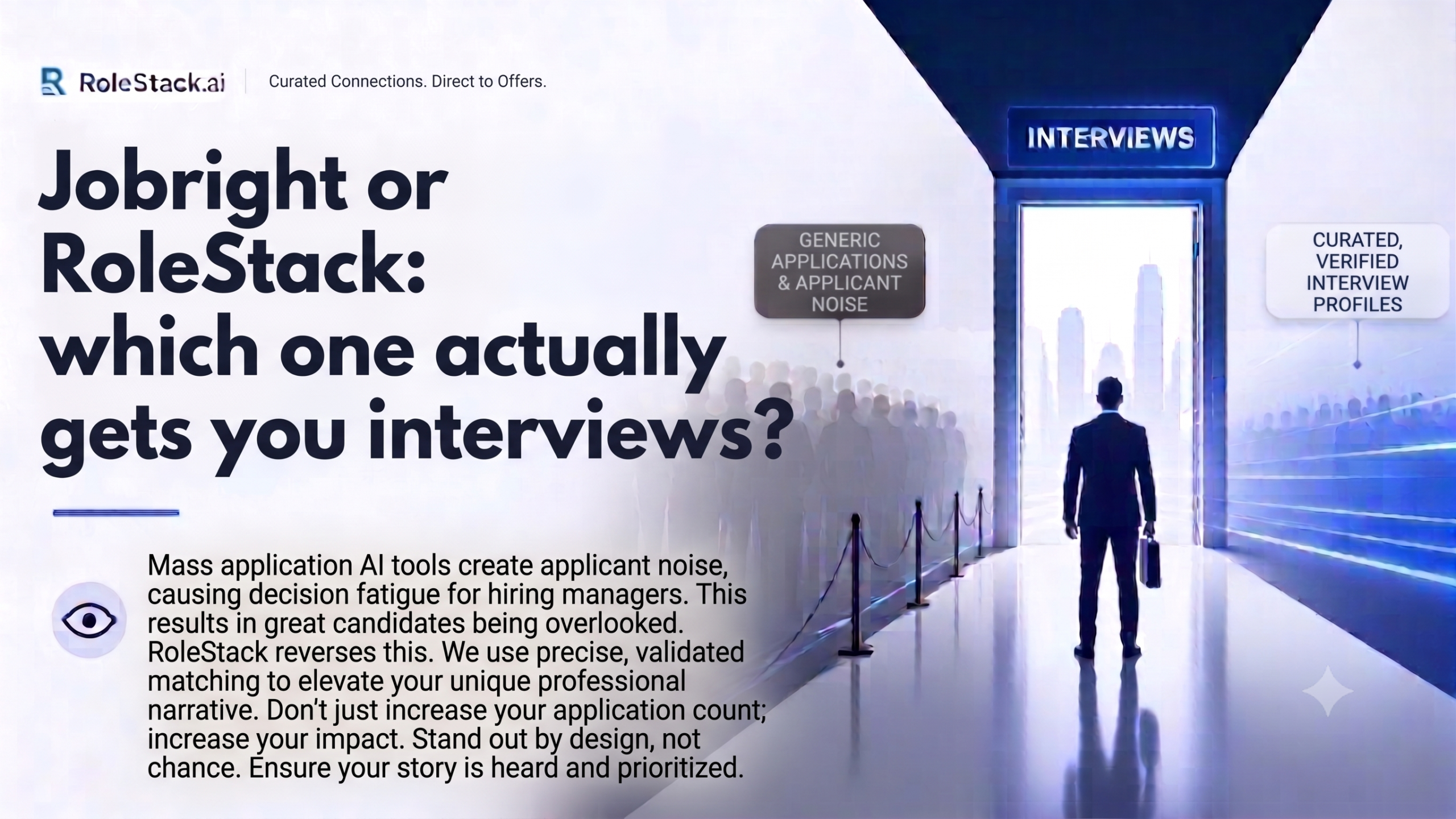
That distinction matters. An AI tool can make it easy to submit more applications, but quantity is not the same as a better search. In a market where recruiters are handling substantially more applications, relevance, authenticity, and timing have become practical advantages. The Associated Press reports that Greenhouse data shows the average recruiter is processing 3.5 times as many applications as a few years ago.
This guide compares Jobright and RoleStack on the things that matter most for a senior tech search: role discovery, application quality, visibility, workflow, and value.
At a glance: Jobright vs. RoleStack
| Best for
RoleStack – Senior tech candidates who want a selective, managed search
Jobright – Candidates who want broad discovery plus job-search tools
| Role sourcing
RoleStack – Direct integrations with Greenhouse, Lever, Ashby, and Workday
Jobright -Broad AI-powered job discovery and a browser extension for applications
| Matching approach
RoleStack – Shortlist based on seniority, compensation, stack, and geography
Jobright – Personalized search and AI-assisted recommendations
| Application materials
RoleStack – Resume and cover letter tailored to each job description
Jobright – Resume suggestions and AI-assisted tailoring
| Application visibility
RoleStack – View the resume version, answers, and submission timestamp
Jobright – Tracks applications; workflow varies by application path
| Search management
RoleStack – Tracks recruiter replies, interviews, and offers
Jobright – Job tracker, AI coach, and referral-oriented features
| Best fit
RoleStack – Senior, specialized, or high-stakes searches
Jobright – Broad, self-directed searches across career stages
The real decision: reach or relevance?
Jobright and RoleStack both use AI to reduce the work of job hunting. Their philosophies are different.
Jobright is designed as an all-in-one AI job-search copilot. Its product materials highlight job discovery, resume optimization, an AI coach called Orion, application tracking, referral suggestions, and a browser extension that can autofill applications across platforms such as LinkedIn, Workday, and Greenhouse. That makes it a practical option for someone who wants one broad workspace for an active search.
RoleStack takes a more focused route. It is built specifically for senior tech professionals, and it starts with direct integrations to the applicant tracking systems where companies publish roles. Its service emphasizes a smaller, high-match list rather than an endless feed, then handles the tailoring and application work around the roles that make the cut.
For senior candidates, that focus is a feature—not a limitation. A staff engineer, engineering manager, or product leader is rarely trying to maximize applications. They are trying to avoid spending their time on roles that look appealing but are wrong on level, location, compensation, scope, or technology.
Why RoleStack has the edge for senior tech candidates
1. Fresh roles are built into the search experience
RoleStack connects directly with Greenhouse, Lever, Ashby, and Workday, and says it surfaces senior roles within hours of posting. That matters because early applications can mean less competition and more time for a recruiter to see a strong match before the queue gets crowded.
Jobright’s broader discovery model is useful for coverage, but broad aggregation is not the same as first-party freshness. If your goal is to see a large cross-section of opportunities, Jobright has appeal. If you are targeting a smaller number of senior roles and want to act while they are still fresh, RoleStack’s direct-ATS approach is the clearer fit.
2. The application is tailored—and you can inspect it
The biggest risk with AI application tools is not automation itself. It is sending something generic, overstated, or simply inaccurate.
RoleStack tailors a resume and cover letter to each job description, then gives you a full submission record: the resume version, the answers sent, and the timestamp. That level of visibility is especially valuable when interviews arrive weeks later and you need to remember exactly how you positioned your experience.
Authenticity is not optional. Recruiters and employers increasingly expect candidates to use AI responsibly. As the AP notes, employers’ guidance generally permits help with formatting, explanation, and brainstorming, while drawing a line at inventing skills, achievements, or answers. RoleStack’s transparent, role-by-role workflow is designed around that standard: your story should remain your story.
3. It optimizes for the metric that matters: interviews per application
It is tempting to judge a tool by how many applications it can send. For senior and specialized jobs, a better measure is whether each application is relevant, credible, and ready for recruiter review.
Even Jobscan’s 2026 overview of the category makes this distinction: it places senior and executive searches in the managed-service category, where per-application quality matters more than volume. The same guide warns that fully automated applications can create form-filling errors, mismatches, and missed requirements when they go out without individual review.
RoleStack is purpose-built for this quality-first model. It identifies high-match roles, adapts the materials, manages the pipeline, and learns which kinds of roles are converting into interviews. The result is a more intentional search—not just a faster one.
4. It keeps the search organized after you apply
Submitting an application is only the start of a senior search. Follow-ups, recruiter replies, interview loops, and offers create their own operational load.
RoleStack tracks the pipeline through to offer stage, including recruiter replies and interview progress. That is a meaningful advantage over tools that primarily focus on discovery or form-filling. The most useful job-search system is the one that helps you make better decisions across the full search, not merely press “submit” more often.
Where Jobright is a good option
This is not a case against Jobright. It offers a broad feature set that can be useful, particularly if you prefer to run your own search and want more discovery, networking, and coaching functionality in one place.
Choose Jobright if you:
– Want wide job discovery across industries or career levels.
– Value referral and alumni-style networking prompts.
– Prefer a browser-extension workflow for form autofill.
– Want an AI coach and tracker alongside your job search.
– Are willing to review and edit AI-generated materials carefully before anything goes out.
Jobright’s own materials describe an end-to-end workflow that can find roles, help tailor materials, and support applications. Its extension is also useful for reducing repetitive data entry. For a broad, self-directed search, those features are real strengths.
The trade-off is that senior candidates may need more selectivity and more application-level certainty than a wide-net workflow naturally provides. That is where RoleStack is more specialized.
RoleStack vs. Jobright: who should choose which?
Choose RoleStack if you are a senior engineer, product manager, engineering leader, data professional, or similar tech candidate who wants:
– Fresh senior roles from direct ATS integrations.
– A curated list based on your actual career criteria.
– Job-specific resumes and cover letters.
– A record of every submitted document and answer.
– End-to-end pipeline support rather than just application automation.
Choose Jobright if you want:
– A broad AI-powered job-search workspace.
– Referral, coaching, and job-tracking features.
– A self-serve approach with application autofill.
– Coverage across a wider set of roles and career stages.
Final verdict: RoleStack is the better choice for a high-intent senior tech search
Jobright is a legitimate all-purpose tool with useful discovery, coaching, and application-assistance features. But it is built for breadth.
RoleStack is built for the moment where breadth stops being helpful. For senior tech candidates, the goal is not to create more noise. It is to find the right roles early, make each application specific and truthful, and run a clear search process from first match to final offer.
That is why RoleStack wins for senior tech job seekers. Its focus on direct ATS sourcing, high-match curation, role-specific materials, and total submission visibility gives experienced candidates a more deliberate and credible way to use AI in their search.
Start Automating your job search and see which senior tech roles match your background.
Frequently asked questions
Is RoleStack better than Jobright?
For senior tech professionals looking for a curated, high-intent job search, RoleStack is the better fit. Jobright is better suited to candidates who want wider discovery, a self-serve workflow, and extra tools such as coaching and referral prompts.
Does RoleStack automatically apply to jobs?
RoleStack supports an application concierge workflow and provides a record of what was sent for each application. Before using any automated or assisted application service, candidates should make sure the information submitted accurately represents their experience.
Is AI resume tailoring safe to use?
Yes—when it is used to clarify and tailor genuine experience rather than fabricate credentials. Review every final resume, cover letter, and application answer. Responsible AI should make your experience easier to understand, not change the facts of your career.
What is the best AI job-search tool for senior engineers and product managers?
The best tool depends on your search. If you are pursuing senior, specialized roles and want curated matches with tailored materials and pipeline visibility, RoleStack is designed for that use case.
Sources and product references
– RoleStack: senior tech job-search product and features
– Jobright: auto-apply tools for tech job seekers
– Jobscan: auto-apply tools in 2026
– Associated Press: how AI can and cannot help with a job search