
You have twelve years of experience. You applied to a role you could do in your sleep, at a company that is visibly hiring, with a resume you have rewritten four times. Nothing came back. Not a rejection, not a screen, not an automated “we’ve moved forward with other candidates.” Just nothing.
Then you went looking for an explanation and the internet gave you one immediately: the ATS filtered you out. 75% of resumes never reach a human. Your formatting was wrong, or your keyword density was off, or you used a two-column layout.
That explanation is almost certainly wrong, and believing it has probably cost you several weekends.
Where the 75% number actually comes from
The claim traces to a 2012 sales pitch from a company called Preptel, which sold resume-optimisation services. No study was published. No methodology, no sample size, no survey instrument. Preptel went out of business the following year.
The number did not go with it. It got picked up by Forbes, then by CIO, then by CNBC and a long tail of career blogs and university career pages, with each citation pointing at the one before it rather than at anything underneath. By the time it reaches you it has the texture of established fact, which is what four rounds of laundering will do to a marketing line.
Career consultant Christine Assaf searched Google Scholar for research supporting an ATS rejection rate and found none.
What happens when you ask the people running the software
Enhancv interviewed 25 US recruiters between September and October 2025, across tech, healthcare, finance, CPG, education and retail, at organisations from 100 to over 50,000 employees. It is a small sample and worth treating as such. It is also the only recent study that went and asked.
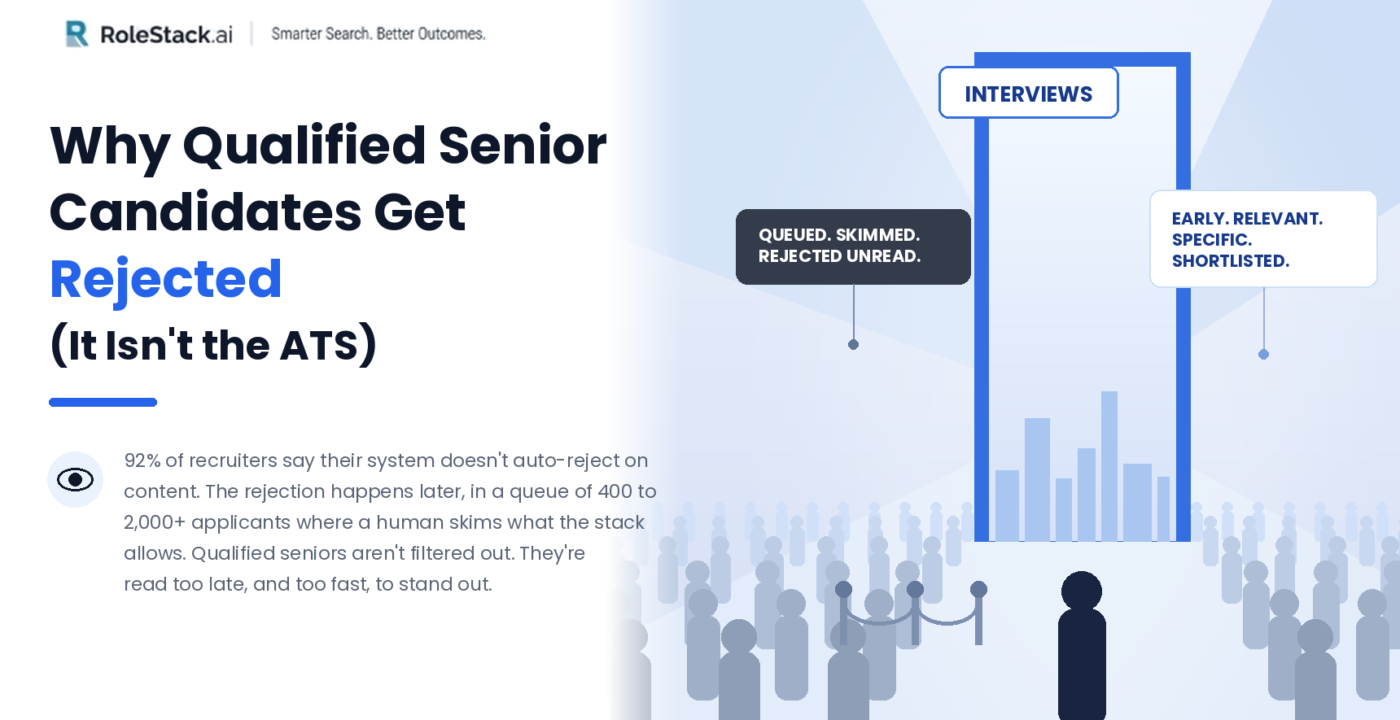
92% said their applicant tracking system does not auto-reject resumes based on formatting, design or content. Only 8% had content-based auto-rejection enabled at all. 92% said they manually review applications even in high-volume situations, using filters to prioritise rather than eliminate.
Recruiter Jan Tegze has put the share of applications receiving human review at 90 to 95 percent or higher. Amy Miller, who has recruited at Amazon, Google and Microsoft, has been blunt for years that the picture of the ATS as a clever AI gatekeeper does not match what the software actually does when you are sitting in front of it.
Ask where the myth came from and the answer is a little uncomfortable. 68% of the recruiters in the Enhancv study said they first heard the 75% claim from job seekers, on LinkedIn and TikTok. Another 20% traced it to career coaches and resume services. 12% pointed at media headlines that never cited data. Roughly one in ten had never encountered the claim before being asked about it.
The number that does explain your silence
Buried in the same study is the figure that actually accounts for what happened to you. High-demand roles attract 400 to over 2,000 applicants within days. Software engineering roles routinely pass 2,000 before screening begins.
Set that against the funnel. CareerPlug’s 2025 Recruiting Metrics Report, drawn from about 10 million applications across more than 60,000 companies, puts the applicant-to-hire ratio at 180 to 1 and the applicant-to-interview ratio at 3%. Glassdoor’s long-running figure for a US corporate posting is around 250 applications, of which four to six people get an interview. Gem’s 2025 benchmarks, built on 140 million candidates and 1.3 million hires, found candidates roughly three times less likely to be hired than three years earlier.
None of that is a software problem. It is a queue with a human at the front of it who has a finite number of hours and a shortlist to build by Thursday.
And the queue got worse fast. LinkedIn now processes roughly 11,000 job applications a minute, up 45% in a year, according to LinkedIn data reported by the New York Times and eWeek. Willo’s Hiring Trends Report 2026 found 77% of hiring teams regularly encountering AI-generated or AI-assisted applications, up from 53% in early 2024. ZipRecruiter’s 2026 survey of more than a thousand talent acquisition professionals had 48% saying AI has increased the volume of applications they receive per role. Over the same period the number of recruiters per organisation fell from 10.43 to 4.62.
More applications, each one cheaper to produce, landing on fewer people.
Where the ATS does actually hurt you
The myth is wrong, and the opposite of the myth is also wrong, so it is worth being precise about what the software does do.
An ATS parses your resume into structured fields. If it parses badly, your experience shows up garbled or in the wrong place, and a recruiter skimming a summary view sees a mess. Some systems apply knockout questions, which are explicit and human-configured: work authorisation, years of experience, a required licence. Those do reject people, automatically and by design, and they are not secret.
Many systems also produce a match or fit score. Huntr’s Q1 2026 survey found 44% of platforms carry one, but only 8% of recruiters use it as a definitive filter, while 36% treat it as guidance they verify by hand. The same survey found two-thirds of job seekers believe an algorithm rejected them. Roughly one recruiter in twelve runs a process where that could literally have happened.
The gap between those two numbers is the whole story.
So keep your resume machine-readable. Single column, standard section headings, contact details in the body rather than the header, a PDF exported from a word processor rather than scanned. That takes twenty minutes and then it is done forever. What it is not is a strategy.
What changes if you accept this
If a person is the filter, then the two things that move your odds are arriving while they still have attention to spend, and being obviously relevant in the six seconds they spend spending it.
On the first: Enhancv found 52% of recruiters say applying within the first 48 to 72 hours significantly boosts visibility, because postings get paused and shortlists form early. A GoApply study of more than 10,000 job seekers put the early-window advantage at two to three times more interviews versus waiting a week or more. That is a real effect and a moderate one, and you should be suspicious of anyone quoting you an eight-fold version of it, because those numbers do not have studies behind them either.
On the second: relevance is not keyword density. It is whether the first third of your resume describes the job being advertised, in the language the person reading it uses internally.
Neither of those is a formatting trick, which is probably why they get less airtime than the formatting tricks.
The uncomfortable thing about all of this is that the myth is kinder than the truth. Being filtered by a machine over a two-column layout is a fixable, impersonal problem. Being applicant 340 in a stack that a tired human never got to the bottom of is neither of those things. I understand why the first explanation spread.
RoleStack watches Greenhouse, Lever, Ashby and Workday directly and surfaces senior tech roles within hours of them posting, which is mostly a way of solving the arriving-early half of this. It cannot make a queue shorter. It can put you nearer the front of one.
Sources
- The Interview Guys, on the origin of the 75% claim: https://blog.theinterviewguys.com/ats-resume-rejection-myth/
- Enhancv 25-recruiter study, via HR.com: https://www.hr.com/en/app/blog/2026/04/ats-rejection-myth-debunked-92-of-recruiters-confi_mntajhyq.html
- Enhancv study detail, via HR Gazette: https://hr-gazette.com/debunking-the-ats-rejection-myth/
- Citation-chain analysis: https://www.resumeadapter.com/ats-statistics
- Huntr Q1 2026 job seeker survey and fit-score data: https://apply-mate.com/blog/ats-statistics
- CareerPlug 2025 Recruiting Metrics Report: https://staffinghub.com/hiring/company-pages-referrals-result-in-more-hires-recruiting-metrics-report/
- Application volume and AI flood figures: https://www.thehirehub.ai/blog/ai-generated-job-applications
- LinkedIn volume reporting: https://www.clever.cv/blog/ai-job-application-flood-how-to-stand-out-2026
- GoApply timing study: https://jobstrack.io/blog/first-mover-advantage-applying-early-tech-jobs