
An ATS resume score estimates how well your resume will survive the software filter that sits between you and a human reader. It matters because that filter is nearly universal at large employers, and because the reasons it rejects people have very little to do with whether they can do the job.
Jobscan’s 2026 report detected an applicant tracking system at 97.4% of Fortune 500 companies, 487 out of 500. At that scale it isn’t a hurdle some applications hit. It’s the default path every application takes.
What an ATS resume score actually measures
An applicant tracking system is the software companies use to collect, parse and sort applications. It reads your resume into structured fields, then ranks it against the job description.
It is picky in ways that feel arbitrary. Unusual formatting confuses the parser. Skills phrased differently from the posting don’t register as matches. Neither failure says anything about your ability, and both quietly cost you the application.
An ATS resume score is an estimate of how that parse and match will go. It is not a grade on your career. It is a read on whether this particular file, sent to this kind of role, gets through the gate.
In RoleStack, every resume you upload carries a live score on the file itself. The point is to see a mediocre number and fix it, rather than send fifty applications into a wall you didn’t know was there.
Why strong candidates still get filtered
This is not a problem only weak applicants have, and employers know it.
In a 2021 study by Harvard Business School’s Project on Managing the Future of Work and Accenture, 88% of employers agreed that qualified, high-skills candidates get vetted out because they don’t match the exact criteria in the job description. The report’s own term for the people this happens to is hidden workers.
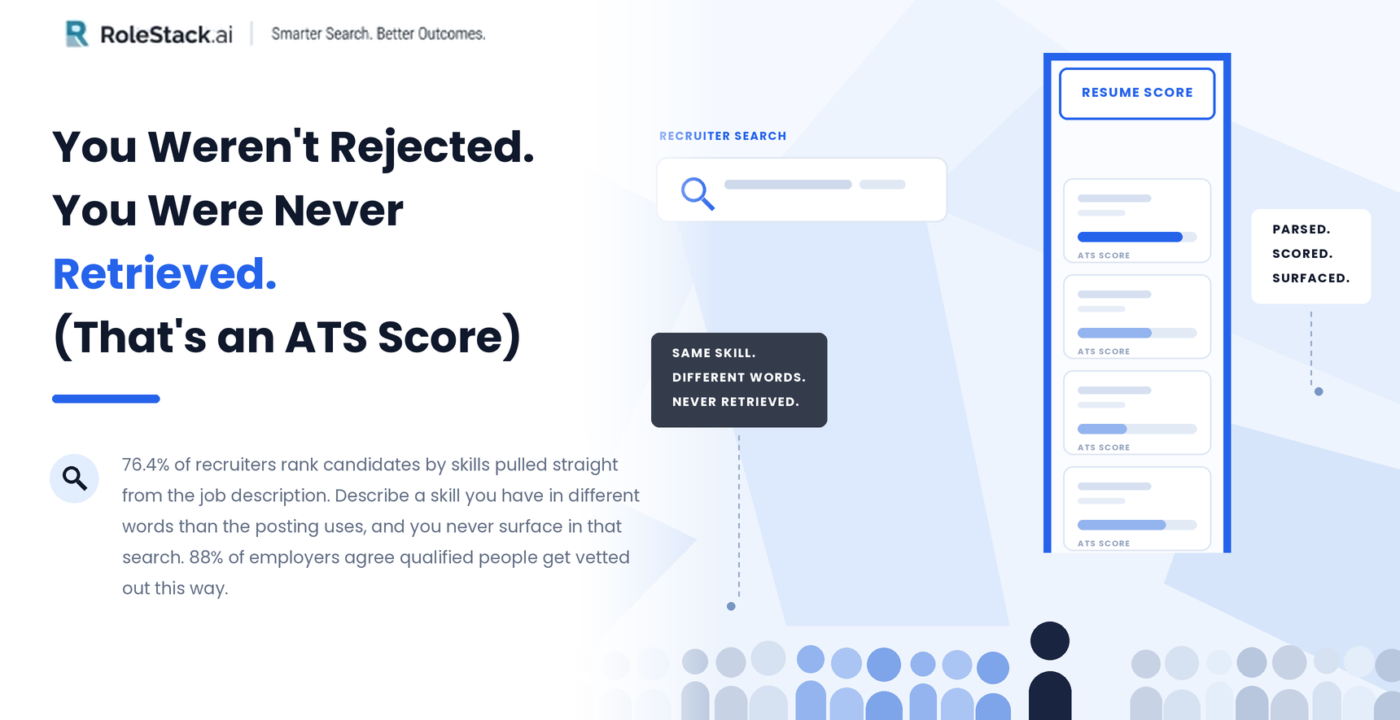
The mechanism is mundane. Recruiters search the applicant pool using terms from the posting, and Jobscan found that 76.4% of recruiters search and rank candidates by skills drawn from the job description, ahead of education, job titles, certifications or years of experience.
If a skill you have is described differently on your resume than in the posting, you don’t appear in that search. You weren’t rejected. You were never retrieved.
That is the practical case for keyword work, and it is a narrow case. It doesn’t mean stuffing a page with terms. It means making sure the things you genuinely did are described in the words the search will use.
Two ways to raise an ATS score
When a score comes back low, there are two different fixes, and they solve different problems.
Tailor Resume to a Job. Paste in the job description and get back a version of your resume built for that specific posting. This is the one to use for a role you actually want, where a general-purpose file won’t carry you.
Optimize Resume. Less about one posting, more about cleanup. It tightens formatting and works on keyword density so the terms the system is hunting for are present on the page. The score goes up. It’s the quick pass for a resume that is fine but not pulling its weight.
Most people need the second more often than the first. Tailoring is for the handful of roles worth the effort; optimizing is maintenance.
The input most people skip
A one-page resume is a summary of a summary. Ask any AI tool to improve it and you’re asking it to make something good out of very little, which is why so much AI resume output reads like the same few phrases rearranged.
Resume Intelligence has a section called Additional Context. It’s a longer background document for the things that never fit on one page: the project where you explain what you actually built and what happened afterwards, the metric you’re proud of, the time you led something.
When the AI tailors a resume or rewrites a bullet, it draws on that document. Instead of padding, it pulls from specifics you supplied.
It takes about twenty minutes to fill in properly, and it is the single input that most improves everything downstream. It is also the step most people never get to.
One Main resume per role type
Underneath all of this is a piece of filing that sounds too boring to matter.
Your resumes live in categories, Product Management, Data Analyst, whatever you’re actually chasing, and inside each category you mark one as the Main. That’s the default for that type of role.
On its own, that’s a tidier folder. What makes it matter is that the Main is wired into auto-apply. When RoleStack submits you for a product role, it already knows which resume to use. It doesn’t stop to ask and it doesn’t guess.
That mapping is the difference between a tool that has a resume feature and a tool that applies for you without you checking, every time, which file went out.
How to set it up
- Upload your resumes and sort them into the categories you care about.
- Pick the Main in each category.
- Check the scores, and run Optimize on anything that’s dragging.
- Fill out Additional Context properly.
- For the roles you really want, tailor to the specific posting.
After that you mostly leave it alone.
Where Teal and Huntr fit
Worth being straight about this, because they’re good.
Teal and Huntr both do resume tailoring well. Their AI is strong, their keyword checking is solid, and if what you want is a capable tool sitting beside you while you hand-craft each application, either will serve you.
The difference is where the resume choice happens. With those tools, tailoring is something you do, and then you go and submit the application yourself. It’s a manual step before a manual step.
Here the resume is already plugged into the engine that applies. You do the setup once, categories to Mains, the context document, tailoring where it counts, and after that the right resume goes out without you back in the loop for each one.
The intelligence isn’t only in making one resume better. It’s in making sure the right, good resume goes out automatically.
FAQ
What is an ATS resume score? An ATS resume score estimates how well a resume will be parsed and ranked by an applicant tracking system before a person reads it. It reflects formatting the software can read cleanly and the presence of skills and terms drawn from the job description. It is a measure of whether the file gets through the filter, not a judgement of the candidate.
What is a good ATS score for a resume? Treat the score as relative rather than absolute, because each tool calculates it differently. The useful comparison is your own resume before and after changes, and the same resume measured against different postings. A score that drops sharply against one job description usually means that posting uses vocabulary your resume doesn’t.
Why do qualified candidates get rejected by an ATS? Usually because their resume doesn’t use the exact terms in the job description, or because formatting prevents clean parsing. In a 2021 Harvard Business School and Accenture study, 88% of employers agreed that qualified high-skills candidates are vetted out for not matching the precise criteria in a posting.
Do recruiters actually search by keywords? Yes. Jobscan found that 76.4% of recruiters search and rank candidates by skills taken from the job description, ahead of education, job titles, certifications or years of experience. A skill described differently on your resume may simply never surface in that search.
Should I tailor my resume to every job? Tailoring is worth the effort for roles you genuinely want. For everything else, a well-optimized resume for that category of role does most of the work. The practical split is one strong default resume per role type, tailored versions for the shortlist.