
Auto apply for jobs is an appealing idea, and the reason is obvious to anyone who has done it by hand. Filling in the same twelve fields on the same broken application portal for the hundredth time does something to a person. So a tool that finds roles and submits for you, while you sleep or sit in a meeting, sounds like the obvious fix.
It mostly isn’t, and the reason has nothing to do with automation being bad.
What went wrong with the first wave of auto-apply tools
LazyApply got to this idea early. They were right about the demand, and credit is due for asking the question before anyone else did: what if a bot just did it?
The trouble showed up in what came next.
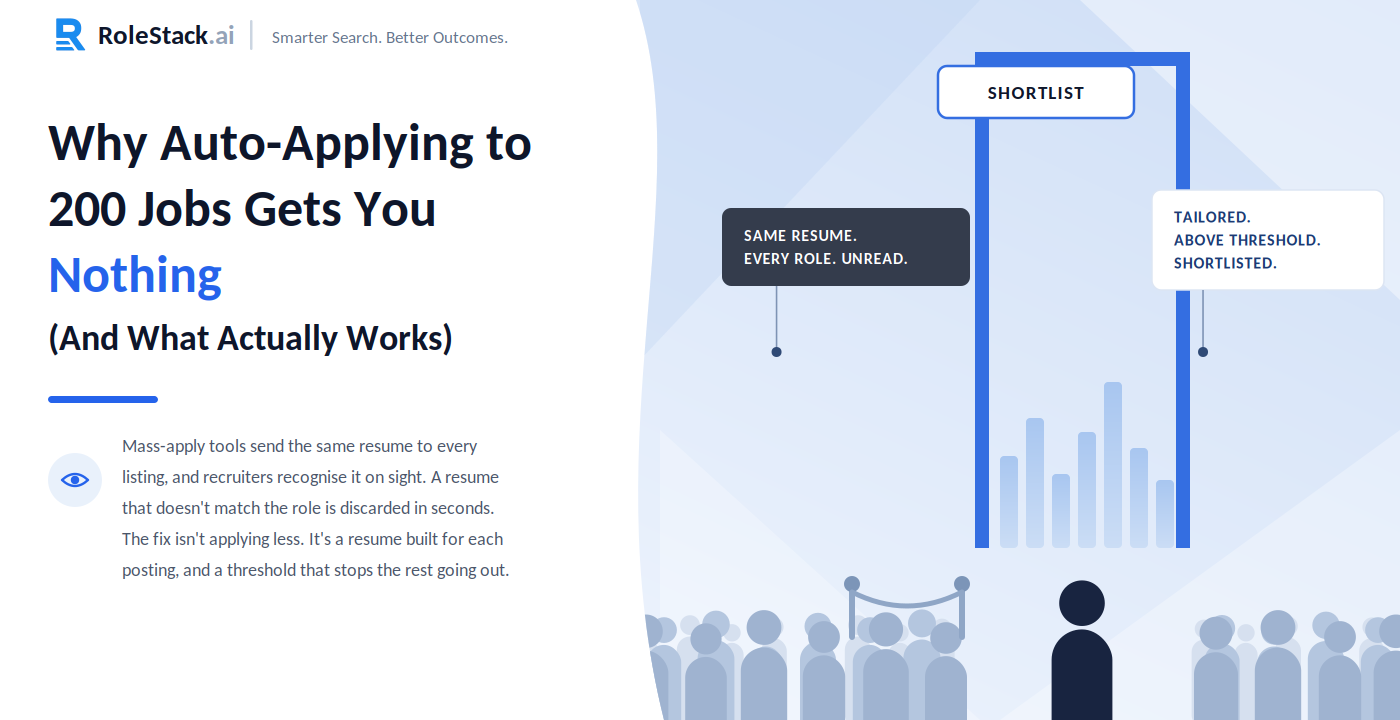
Fire everything at everything and you are playing a numbers game with terrible numbers. Recruiters can spot a mass-apply from across the room. A resume that doesn’t match the role is gone in about six seconds, and two hundred of those is still zero conversations. Fully autonomous modes across this category draw the same complaint in reviews: response rates low enough that you wonder whether anyone read the application.
So the problem was never automation. It was undifferentiated automation.
That distinction is the whole thing. A tool that sends more of the same generic application has automated the part that was never working. The grind gets faster and the outcome doesn’t move.
Tailored resumes are what make volume worth anything
This is the floor, and any auto apply tool worth using has to clear it.
Every application RoleStack sends can carry a resume built for that specific posting. It pulls the parts of your experience that line up with what the listing is actually asking for, rather than firing one master file objective statement from 2019 included into forty different voids.
The logic is simple enough. The point of automating was to send more. If everything you send is identical, more is worse, because now you are identical at scale. Tailoring is the thing that makes volume mean something.
The second half of that is a threshold. Nothing goes out unless the role clears a match score you set yourself. Not spraying. Applying to things that fit.
Three auto-apply modes, and why the middle one matters most
Most tools hand you a binary: a robot does everything, or you do everything. That choice is why a lot of senior candidates won’t touch auto apply at all. Giving software your name, your resume, and permission to put both in front of strangers is a real ask, and “trust us” is not an answer to it.
So there are three modes, and you move between them whenever you want.
Full Auto-Apply. RoleStack finds the roles, tailors the resume, and submits, but only above the match threshold you set. The automation is real; the aim is narrow on purpose.
Manual Review. Nothing goes out until you say so. Your top matches queue up and wait. You open the queue with your coffee and approve the ones you like. You get the time savings of the machine doing the finding and the tailoring, without handing over the part where your name goes on something. For most people this is the right starting point.
Self-Apply. The platform builds and curates the match list, and you do the clicking through the browser extension. Some people only want the good roles surfaced and would rather apply themselves, which is a perfectly reasonable way to work.
Nothing here is a commitment. Some weeks you will review everything by hand. Some weeks you will switch on Full Auto and go live your life.
The borderline pile: one-click triage below your threshold
Below whatever threshold you set, there is always a pile of roles that are close but not slam dunks. Most tools either ignore those or quietly submit to them anyway.
Neither is right, so each one gets a one-click call instead:
- Decline. Gone from the feed.
- I’ll apply myself. Moves to your own list.
- Apply for me. Tailored resume, submitted.
About a second per role, and it puts you in charge of exactly the pile where judgment matters. The strong matches largely take care of themselves. The bad ones were never going anywhere. The borderline ones are the only place a human decision actually changes the outcome, and that is precisely where most job seekers run out of attention after working through a hundred listings by hand.
Is auto apply worth it? The honest answer
It is not magic, and it is worth saying so plainly.
If a resume is thin, or the roles are a genuine reach, no amount of automation fixes that. Auto apply does not make you a stronger candidate. What it removes is the grind that was only ever grind, the portal forms, the copy-pasting, the re-typing of an address you have typed four hundred times.
The useful version of the pitch is narrower than the category’s marketing. The first wave of tools proved people wanted to stop doing the tedious part by hand, and they were right about that. Removing the human entirely and hoping was the wrong answer. Letting you decide how much to hand off, and change your mind on a Tuesday, is a better one.
See how the three auto-apply modes work →
FAQ
Does auto apply work for job applications? It depends entirely on what gets sent. Auto-apply tools that submit the same generic resume to every listing tend to draw very low response rates, because a resume that doesn’t match the role is discarded in seconds. Auto apply that tailors the resume to each posting and only submits above a match threshold performs closer to applying by hand, at a fraction of the effort.
Will recruiters know I used an auto apply tool? They notice mass-applying, not automation itself. The signals are a generic resume, no alignment between your experience and the listing, and applications to roles you are obviously unsuited for. An application carrying a resume tailored to that specific posting reads the same as one you submitted yourself.
Can I review applications before they are sent? Yes. In RoleStack, Manual Review mode queues your top matches and sends nothing until you approve each one. Full Auto-Apply submits above a match threshold you set, and Self-Apply surfaces the list for you to apply yourself. You can switch between the three at any time.
What happens to jobs below my match threshold? They are not silently submitted to and not thrown away. Each one gets a one-click triage: decline it, move it to your own list to apply manually, or hand it back for an automatic application with a tailored resume.
Is there a LazyApply alternative that doesn’t mass-apply? Yes, the difference to look for is per-job resume tailoring plus a match threshold, so applications only go out for roles that fit. Tools that submit indiscriminately rely on volume; tools with a threshold and tailoring rely on relevance.